This post is also available in other languages:








Content Reuse Policy
You may reproduce or adapt this content for educational or commercial use with proper attribution and a link to: the original blog post Include a visible credit near the reused content with a standard hyperlink to the source.
VW Golf Mk7 & Mk7.5 LED Headlights Guide — GTI-Style Upgrade, Switchable Yellow & Red DRL, Fitment & Taillights
The complete Eleron guide for Golf Mk7 & Mk7.5 lighting: Mk7.5 GTI-style full LED headlights with switchable yellow and red DRL, the Silver/Red/Black accent-line combinations, halogen vs xenon fitment and coding, OEM part number cross-reference, plus the laser and R-style taillights that finish the car.
Related Products
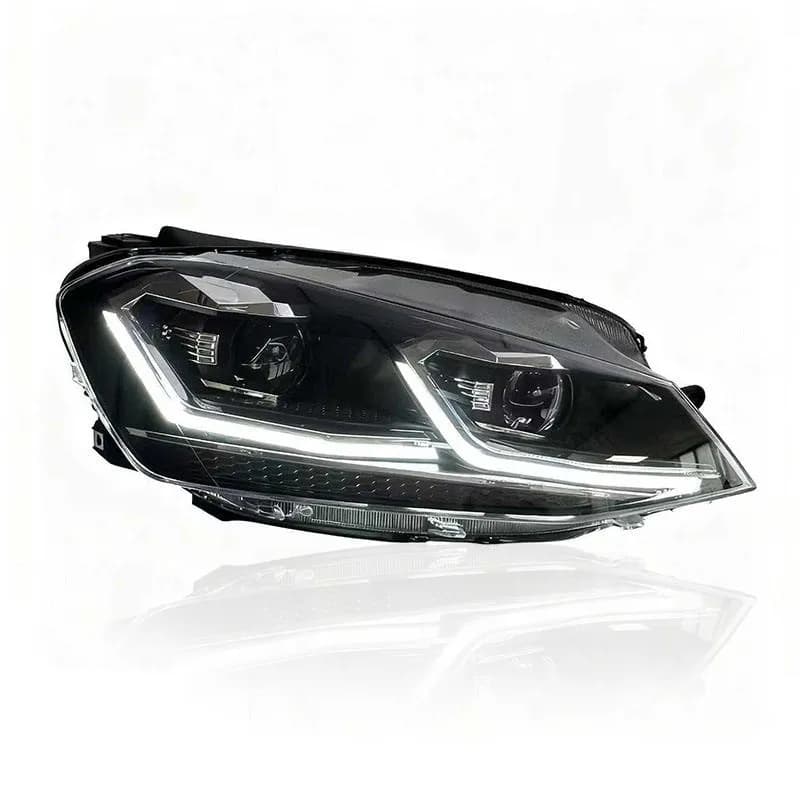
SKU: GOLF-MK7-05817
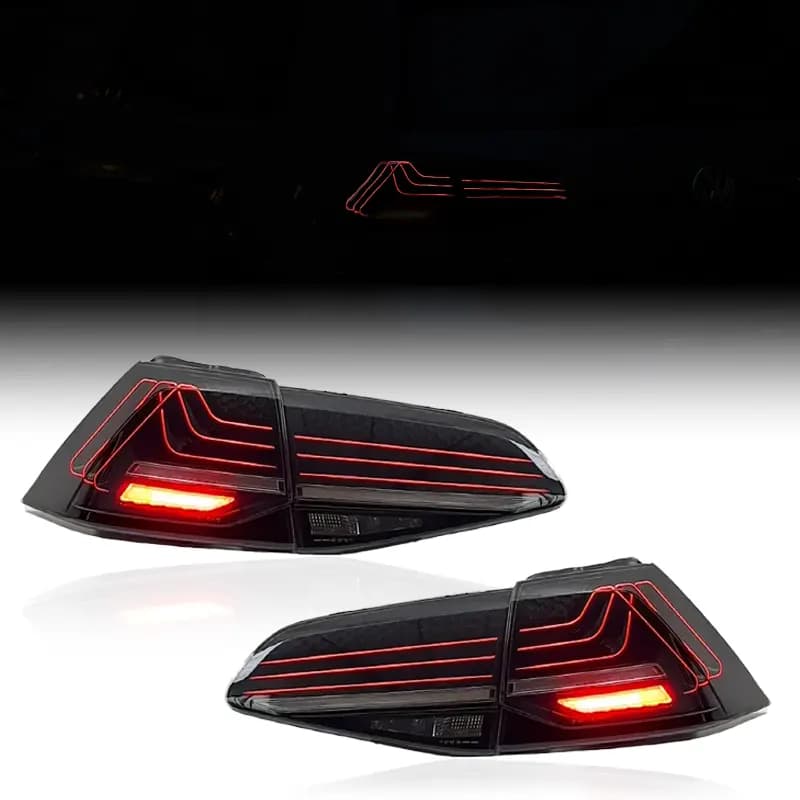
SKU: GOLF-MK7-05816
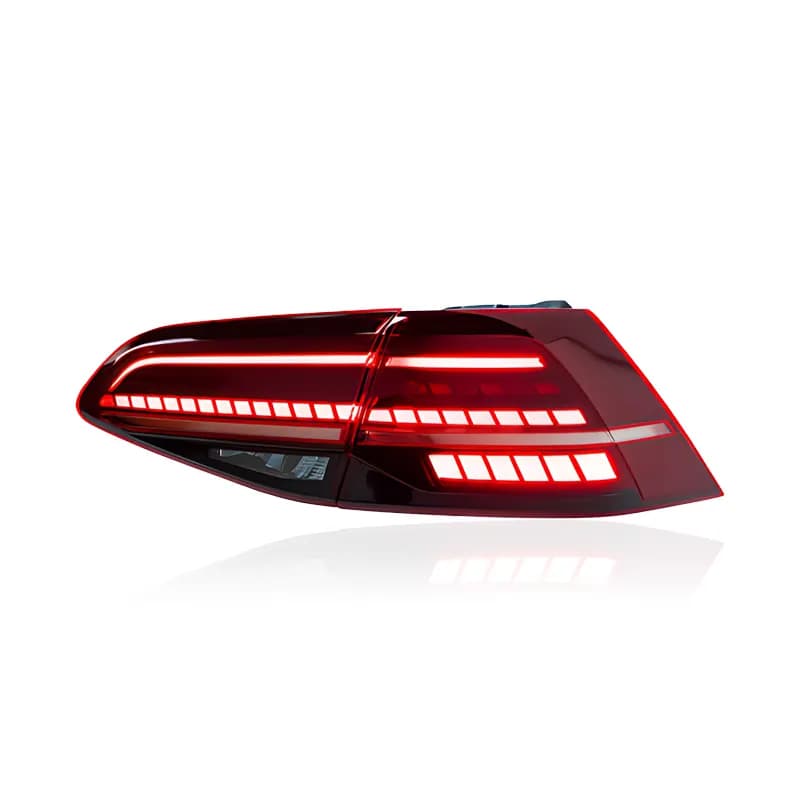
SKU: GOLF-MK7-05815
Related Vehicles
The Golf 7 is Europe's default car — and its factory lighting is the one place the base versions feel cheap. Dim halogens on most trims, a facelift light signature reserved for the newest and highest-spec cars, static indicators on a platform whose facelift made sweeping ones famous. This guide covers the full ELERON lighting upgrade for Golf Mk7 (2012–2017) and Mk7.5 (2017–2021) — hatchback and wagon, GTI, Golf R and GTE included: the Mk7.5 GTI-style full LED headlights with switchable yellow or red DRL, how the accent-line combinations work, exact halogen/xenon fitment and coding, and the matching laser and R-style taillights that finish the car.
The 60-second version
One headlight platform, four decisions: (1) Generation — Mk7 and Mk7.5 bumpers differ, and a dedicated housing exists for each, so pre-facelift cars get the facelift look with no bumper work. (2) Factory type — halogen cars are fully plug-and-play; xenon cars plug in the same way, and AFS-equipped cars need one 5-minute VCDS step (we provide the instructions). (3) DRL color — fixed White, switchable White/Yellow, or switchable White/Red, toggled from the high-beam stalk. (4) Accent lines — Silver or Red lines pair with the single-color White DRL; Black lines are exclusive to the dual-color White/Yellow and White/Red versions.
1) Why Golf 7 owners upgrade the lights
Halogen output that was never enough
Most Mk7s left the factory with halogen headlights, and a decade of lens aging hasn't helped. The short, yellow-tinted beam makes dark-road and winter commutes genuinely tiring — if your search started with "Golf 7 headlights too dim," this is the car it was written about. Brighter bulbs can't fix aged optics; modern bi-LED projectors replace the whole equation with a wide, white beam and a sharp cutoff.
The facelift look gap
The Mk7.5 facelift gave the Golf its best-ever face — the dual-L LED signature and sweeping indicators — but only on facelift cars, and the sharpest lighting only on higher trims. A 2013–2016 Mk7 can't get there with factory parts without a bumper-and-harness project. Dedicated housings solve that.
Aging xenon economics
Xenon Golfs light well when healthy — but ballasts, ignitors, and leveling components fail with age, usually one side first, and genuine parts plus labor climb quickly on a 10-year-old assembly. A complete new LED assembly retires every one of those failure points at once.
A signature nobody else has
Every second car in the parking lot is a Golf. A switchable yellow or red DRL — toggled from the driver's seat — is the difference between yours and the other five in the row, without touching the paint or the bumper.
2) The Mk7 → Mk7.5 look, without changing bumpers
The Mk7 and Mk7.5 use different bumper shapes, which is exactly why factory facelift retrofits are a project. These headlights sidestep it: the Mk7 version puts the Mk7.5 GTI light design — dual-L DRL, sequential sweeping amber indicators, bi-LED projectors — into a housing shaped for the pre-facelift bumper. The Mk7.5 version is a direct-fit replacement that upgrades factory halogen or xenon facelift cars to the full LED spec. Both fit hatchback and wagon/Variant, standard trims and GTI, Golf R, and GTE alike. Not sure which generation you have? The quickest tell is the registration year — Mk7 runs 2012–2017, Mk7.5 from the 2017 facelift — and when in doubt, your VIN settles it: send it over and we'll confirm.
3) Golf 7 Yellow DRL — the switchable rally signature
Selective yellow is motorsport language — French rally headlights, endurance racers, and lately the yellow DRL wave that started on BMW's CSL models and spread across the tuning world. On a Golf it lands differently than on anything else: the everyman's car wearing a works-team face.
The key word is switchable. This is not a fixed yellow film or a locked yellow board: flash the high-beam stalk 6× and the dual-L signature turns deep yellow; flash 5× and it's back to crisp factory-style white. The headlight remembers your choice through ignition cycles. White for the daily commute, yellow when the setting calls for it — no tools, no apps, no crawling behind the bumper.
4) Golf 7 Red DRL — the most aggressive front end this platform can wear
Red DRLs are the newest corner of the DRL scene, and the rarest — which is precisely the appeal. GTI owners get the obvious pairing with the red grille stripe that's defined the badge since the Mk5; show builds get a front end nobody else at the meet has.
Same switching logic as yellow: 6× on the stalk to red, 5× back to white, selection remembered across ignition cycles. And the same honest usage guidance: the White mode is the one designed for everyday road driving — treat yellow and red as the show-and-event signature and use them as intended in line with local expectations. That switchability is the whole point: a fixed red DRL commits you; this one is a choice you make per moment.
5) Accent lines: Silver, Red, Black — and how they pair
The accent line is the fixed styling strip inside the housing — separate from the switchable DRL color, and the two are not freely mixable. The lineup is deliberately structured:
Silver Lines
Clean and refined — the Golf R / high-trim appearance. Paired exclusively with the single-color White DRL: the understated OEM+ build.
Red Lines
The GTI signature, echoing the red grille trim. Also paired exclusively with the single-color White DRL — GTI identity by day, no switching.
Black Lines — the ultimate spec
The most aggressive look in the range, and the only trim sold with the switchable White/Yellow and White/Red DRLs. If you want the color-changing signature, Black Lines is your housing.
| Accent lines | White (fixed) | White / Yellow | White / Red |
|---|---|---|---|
| Silver | ✓ | — | — |
| Red | ✓ | — | — |
| Black | — | ✓ | ✓ |
Simple rule of thumb: fixed white → Silver or Red lines · switchable colors → Black lines.
6) Fitment & coding: halogen, xenon, AFS
Factory halogen cars
Fully plug-and-play: install, test, drive. No coding of any kind. All LED drivers and control electronics ship pre-installed — nothing is transferred from your old units, and your factory headlights stay intact for resale or a lease return.
Factory xenon cars (incl. AFS)
Same physical install — plug in and everything lights up either way. The one extra step applies only to AFS (adaptive) cars like many GTI, Golf R, and GTE builds: because the LED units don't physically swivel, the car shows an adaptive-lighting warning until AFS is disabled via VCDS or a compatible VAG tool. It's a single parameter, about 5 minutes at any VAG-familiar workshop — and we provide the step-by-step coding instructions with every xenon order, so you or your shop aren't guessing. No long-coding, no multi-module work.
On markings: these assemblies are E-marked, and the White DRL mode is the configuration designed for everyday road driving. If you want the deeper background on lens markings and what inspectors look at, it's all in our E-mark & ECE lighting guide.
OEM part number cross-reference (tap to expand)
The fastest confirmation: read the VW part number on your headlight and match it below. Every factory number maps to one of the two versions — Halogen or Xenon — in your generation.
| Factory headlight | OEM part numbers (L / R) |
|---|---|
| Mk7 Halogen (RHT) · 2012–2017 | L: 5G1941005 / 5G1941005E · R: 5G1941006 / 5G1941006E |
| Mk7 Halogen (LHT) · 2012–2017 | L: 5G2941005 / 5G2941005E · R: 5G2941006 / 5G2941006E |
| Mk7 Xenon (RHT) · 2012–2017 | L: 5G1941039 · R: 5G1941040 |
| Mk7 Xenon GTI (RHT) · 2012–2017 | L: 5G1941039A · R: 5G1941040A |
| Mk7 Xenon (LHT) · 2012–2017 | L: 5G2941039 · R: 5G2941040 |
| Mk7 Xenon GTI (LHT) · 2012–2017 | L: 5G2941039A · R: 5G2941040A |
| Mk7 Xenon Adaptive (RHT) incl. LED DRL · 2012–2017 | L: 5G1941753 · R: 5G1941754 |
| Mk7 Xenon Adaptive GTI (RHT) · 2012–2017 | L: 5G1941753A · R: 5G1941754A |
| Mk7 Xenon Adaptive Golf R (RHT) · 2012–2017 | L: 5G1941753D / 5G0941753C · R: 5G1941754D / 5G0941754C |
| Mk7 Xenon Adaptive (LHT) · 2012–2017 | L: 5G2941753 · R: 5G2941754 |
| Mk7 Xenon Adaptive GTI (LHT) · 2012–2017 | L: 5G2941753A · R: 5G2941754A |
| Mk7 Xenon Adaptive Golf R (LHT) · 2012–2017 | L: 5G2941753D · R: 5G2941754D |
| Mk7 Xenon Dynamic (RHT) · 2012–2017 | L: 5G1941043 · R: 5G1941044 |
| Mk7 Xenon Dynamic GTI (RHT) · 2012–2017 | L: 5G1941043A · R: 5G1941044A |
| Mk7 Xenon Dynamic GTE (RHT) · 2012–2017 | L: 5G1941043B · R: 5G1941044B |
| Mk7 Xenon Dynamic Golf R (RHT) · 2012–2017 | L: 5G1941043E · R: 5G1941044E |
| Mk7 Xenon Dynamic (LHT) · 2012–2017 | L: 5G2941043 · R: 5G2941044 |
| Mk7 Xenon Dynamic GTI (LHT) · 2012–2017 | L: 5G2941043A · R: 5G2941044A |
| Mk7 Xenon Dynamic GTE (LHT) · 2012–2017 | L: 5G2941043B · R: 5G2941044B |
| Mk7 Xenon Dynamic Golf R (LHT) · 2012–2017 | L: 5G2941043C / 5G2941043E · R: 5G2941044C / 5G2941044E |
| Mk7.5 Halogen (RHT) · 2017–2021 | L: 5G1941005D · R: 5G1941006D |
| Mk7.5 Halogen (LHT) · 2017–2021 | L: 5G2941005D · R: 5G2941006D |
This covers the most common references — some market-specific or late-production numbers may not be listed. Number not shown? Send us your VIN and we'll confirm.
7) Install & aiming
The swap (2–3 hours)
- Remove the front bumper — standard Golf 7 procedure with basic hand tools.
- Unbolt the factory headlights, disconnect the main harness plug.
- Plug the new units into the factory harness — no adapters, no wire cutting.
- AFS cars only: run the provided VCDS step to disable AFS and clear the dashboard warning.
- Test before reassembly: low beam, high beam, DRL, sequential indicators — and on dual-color versions, the switching: 6× to yellow/red, 5× back to white.
- Reinstall the bumper and set beam height with the integrated adjusters.
Aiming: ten minutes that make the beam
A sharp bi-LED cutoff aimed too high is glare for oncoming traffic; too low and you waste the output you just installed. Ten minutes against a wall with the 1% rule gives you the crisp, non-glare pattern these projectors are built for — full walkthrough in our headlight aiming guide. If anything behaves oddly after install — flicker, warnings, fast indicators — start with our CANBUS & LED error guide.
8) Finish the rear: laser & R-style taillights
A facelift-look front with tired factory rears is half a transformation. Two directions, depending on what the front end you chose says:
CSL Laser-Style Taillights — the unique one
Ultra-thin laser-etched light filaments in the CSL style — a rear signature that exists nowhere in VW's factory catalog and pairs naturally with the yellow or red DRL front. Complete 4-piece set (outer + tailgate units), sequential indicators, startup animation on lock/unlock, Red or Smoked housing, zero coding.
GTI / R-Style Taillights — the popular one
The Mk7.5 GTI/R facelift signature for any trim — full-width LED bar, sequential indicators, startup animation. On a pre-facelift Mk7 it's the facelift conversion for the rear; on a base Mk7.5 it's the step up to the R look. Complete 4-piece set, Red or Smoked housing, zero coding. Our best-selling Golf rear.
Note: both taillight sets are for hatchback models only (the Variant/estate uses a different shape) and are designed for EU and UK market vehicles. The headlights above fit hatchback and wagon alike.
9) FAQs — Golf Mk7 / Mk7.5 lighting upgrades
Can I get yellow DRLs on a Golf 7?
Can I get red DRLs on a Golf 7 or GTI?
I have a 2015 Mk7 — will these give it the Mk7.5 facelift look?
My Golf has xenon (or AFS) headlights — what coding is needed?
Which accent lines can I combine with which DRL?
Will LED actually be brighter than my factory halogens at night?
Does this fit the GTI, Golf R, GTE, and the Wagon/Variant?
Do matching taillights exist?
Build your Golf's light signature
Every pair is configured to your exact car — generation, halogen or xenon, DRL color, accent lines, driving side — and bench-tested before shipping, with a 2-year warranty and 14-day free returns. Not sure about your configuration? Send your VIN and we'll confirm generation and headlight type.
© Eleron Lights — Lighting built for clean output, tidy fitment, and real-world usability. More articles.