This post is also available in other languages:









Content Reuse Policy
You may reproduce or adapt this content for educational or commercial use with proper attribution and a link to: the original blog post Include a visible credit near the reused content with a standard hyperlink to the source.
BMW F10/F11 Headlight Upgrade Guide (2011–2017): Halogen & Xenon to Full LED — Problems, Options & Honest Tradeoffs
Condensation, failing ballasts, dim halogens — the F10's headlights age before the rest of the car. How to identify your exact variant, compare repair vs used OEM vs new Full LED, and the two tradeoffs nobody mentions.
The BMW 5 Series F10/F11 (2011–2017) is now a 10–15-year-old car — and its headlights are usually the first place that age shows. Hazy lenses, condensation after every rain, xenon ballasts giving up one side at a time, halogens that were dim even when new. This guide walks through the whole decision: how to identify exactly which headlights your F10 has, what the three realistic upgrade paths cost and involve — repairing the originals, retrofitting used factory LED units, or fitting new OEM+ Full LED assemblies — and the honest tradeoffs of each, including the two limitations most sellers won't mention.
Everything here applies equally to the F10 Sedan and F11 Touring — they share identical headlight geometry, mounts, and connectors. That includes the M5 F10.
1) Why F10 headlights fail — the platform's known weak points
If you're reading this, one of these probably brought you here:
Condensation and moisture
The F10's most common headlight complaint — and it's not just cosmetic. A decade of heat cycling ages the housing seals until every wet week leaves fog on the inside of the lens. The moisture then finds the TMS driver module mounted on the headlight — the unit controlling leveling, angel eyes, indicators, and the adaptive function — and corrodes its board and connector pins. Most F10 "electrical" headlight failures start as a water leak.
TMS module and ballast failure
The classic F10 symptom set: one side loses its angel eyes, sidelights, or indicator, the dash throws "Adaptive Headlight Malfunction" or "Vertical Aim Control" warnings, or a headlight flickers. That's usually the moisture-damaged TMS module, not a bulb. Xenon ballasts and ignitors add their own failure clock on top — typically one side first, leaving the car winking.
Dim halogen output at night
Pre-LCI halogen cars were modest even in 2011. Fifteen years of lens hazing and reflector aging later, night visibility on many cars is genuinely marginal — a short, yellow-tinted beam that makes dark-road and winter commutes tiring. If your search started with "F10 headlights too dim," this is why: it's not the bulbs, it's the whole aging assembly, and brighter bulbs alone can't fix hazed optics.
The tired face
Yellowed lenses and dated halo rings age the whole front end. The F10's design still holds up — the lighting is what gives its year away, especially parked next to anything with a modern LED signature.
2) First: identify your exact headlights
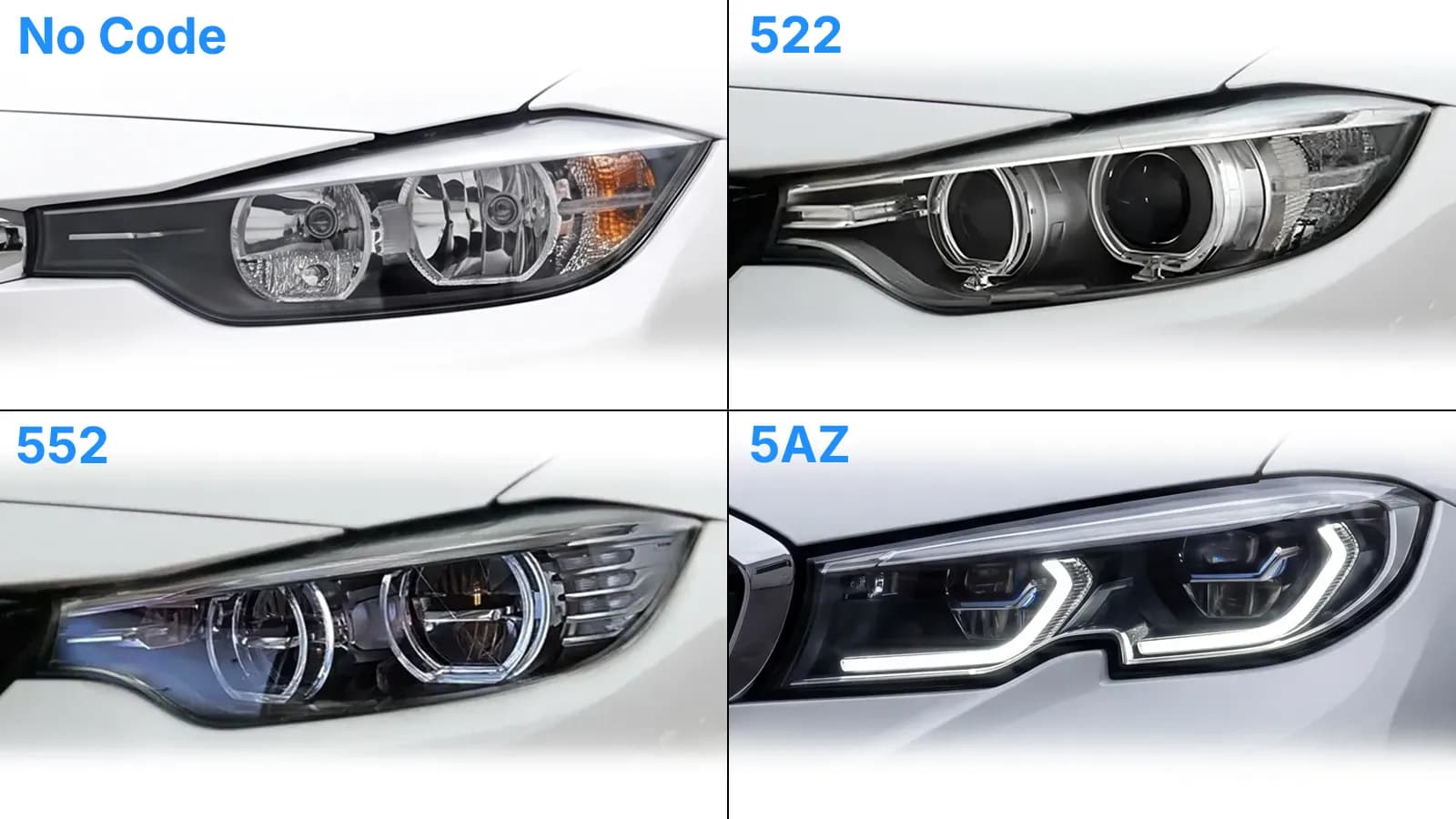
Everything downstream — cost, parts, which upgrade version to order — depends on which of the F10's headlight variants you have. There are four, across two body phases:
| Variant | Years | How to recognize it |
|---|---|---|
| Halogen (base, pre-LCI) | 2011–2013 | Visible replaceable bulbs in open reflectors behind the corona rings; manual beam-height thumbwheel on the dashboard. |
| Xenon (522), standard | 2011–2013 pre-LCI · 2014–2017 LCI | Projector lens behind the rings, no dashboard leveling wheel (leveling is automatic). LCI units have the reshaped "eyebrow" LED accent and corona design. |
| Adaptive Xenon (522 + 524, AFS/AHL) | 2011–2017 | Looks identical to standard xenon from outside — the beams swivel with steering. Test below. |
| Factory Full LED (552) | LCI, rare | No bulbs or projector "eyes" behind the rings — full light-guide internals. If you have these, the upgrade below is not for your car. |
The AFS test — do it right, or it lies to you
- Set the light switch to AUTO — not the manual low-beam position.
- Wait until it's dark enough that the low beams actually switch on. The test only works with low beams lit.
- Engine running, low beams on: turn the steering wheel left and right (stationary is fine).
- Beams swivel with the wheel → you have Adaptive Xenon (AFS/AHL). Beams stay fixed → standard headlights.
Want the ground truth instead of eyeballing? Decode your VIN and read the option codes — 522, 524, 552 — using the exact walkthrough in our BMW headlight identification guide. Or send us your VIN and we'll confirm your variant for you.
3) The three upgrade paths, compared honestly
There is no single right answer for every F10 — it depends on what's broken, your budget, and how long you're keeping the car. These are the three realistic paths:
A) Repair the originals
New ballasts/bulbs, a TMS module, lens polishing, reseal against moisture. Right when one specific part failed on an otherwise dry, healthy unit and the budget is tight. The real-world math from owner forums: genuine TMS modules run around €400 per side, replacements on adaptive cars typically need dealer-level (ISTA) coding, and used adaptive xenon assemblies trade well above €1,000 each. And the loop problem: a new module doesn't fix the leak that killed the old one — unless the housing is resealed properly, moisture claims the replacement too. Polished lenses re-haze on the same clock.
B) Used factory LED (552) retrofit
Sourcing used LCI Full-LED units. You get the factory LED look — but the honest picture: the units are rare and expensive used, they're as old as the platform with no warranty, and because your car wasn't built for them, the retrofit needs wiring adaptation and coding work. You inherit someone else's decade-old electronics at a premium price.
C) New OEM+ Full LED assemblies
Complete new housings with Bi-LED projectors, LED DRL/indicators, everything pre-installed, built for your exact harness — halogen or xenon, pre-LCI or LCI, standard or AFS. New seals, new electronics, plug-and-play, no coding, 2-year warranty. One decision instead of a repair treadmill. The tradeoffs — and there are real ones — are in section 5.
| Repair OEM | Used 552 retrofit | New OEM+ Full LED | |
|---|---|---|---|
| Fixes condensation & ballast risk | Partially, temporarily | Inherits used seals | Yes — new sealed housings, no ballasts at all |
| Modern LED look | No | Yes | Yes |
| Coding required | No | Yes, plus wiring work | No — plug-and-play on every variant |
| Warranty | Parts only | None | 2 years, electronics and housing |
| AFS swivel retained | Yes | Depends on donor/coding | No — fixed Bi-LED projectors (see tradeoffs) |
4) What the OEM+ Full LED upgrade actually changes
True Bi-LED projectors
One high-output LED module handles low and high beam through a solenoid-actuated shutter — the same architecture as modern OEM units. Low beam, high beam, DRL, and indicators are all LED. No bulbs to source, no xenon warm-up, no D-series burners, and the whole ballast failure category disappears from your car.
Ships complete — nothing to transfer
LED drivers, projector modules, and DRL electronics arrive pre-installed. Your factory halogen or xenon units come out intact — keep them as spares or sell them, which offsets a real part of the upgrade cost on xenon cars.
Native on the F10's electronics
Internals are pre-programmed for the F10's LIN-bus and FRM3 footwell module: cold-check passes, dimming, flash-to-pass, welcome lighting and Follow-Me-Home all work with no coding, no adapters, no bulb-out warnings. If you've read our CANBUS & hyper-flash guide, this is the failure mode cheap retrofits hit — and the one this design avoids.
Sealed against the F10's classic enemy
High-strength polycarbonate lenses on ABS housings, sealed at every joint in manufacturing. With no ballast heat-cycling inside, the moisture cycle that kills aging F10 units doesn't get started.
5) The two honest tradeoffs
Most product pages hide these in a spec row. They matter, so here they are in plain language:
AFS cars: the swivel is not retained
The new housings use fixed Bi-LED projectors — they don't physically pivot with steering like the original AFS units. Adaptive cars remain fully plug-and-play with no coding and no errors; you trade the swivel for a brighter, sharper static beam with none of the swivel motor's wear points. If cornering swivel is non-negotiable for you, this isn't your upgrade — that's an honest line we'd rather draw here than in a support email.
Halogen cars: the dashboard leveling wheel won't work
Factory halogen F10s adjust beam height with a manual thumbwheel in the cabin. The new LED units don't respond to that dial — beam height is set once, mechanically, with the integrated adjusters during installation, using the standard wall method. Set it correctly and you won't miss the wheel; our 1% aiming guide shows exactly how. Xenon cars are different: their automatic self-leveling is fully retained — the LED drivers read the factory ride-height signal, so the beam still compensates for a loaded trunk or rear passengers, with no leveling faults in iDrive.
6) DRL choice: clean White or switchable White/Yellow
White (single color)
Fixed white DRL with a sharp, contemporary signature. The understated choice — an honest OEM+ upgrade that looks like the LCI LED headlights the F10 should have had.
White + Yellow (switchable)
The CSL motorsport signature on demand: flash the high-beam stalk 5× to toggle between crisp White (~6,000K) and Selective Yellow (~3,000K). White for daily driving and inspections, yellow when the setting calls for it. The full legality logic behind switchable DRLs is in our CSL DRL guide.
7) Fitment: pre-LCI, LCI, halogen, xenon, AFS
One housing platform, three dedicated harness versions — order the one matching your factory headlights:
| Your factory headlights | Years | What to order |
|---|---|---|
| Halogen | 2011–2013 | Pre-LCI Halogen version |
| Xenon, standard or Adaptive (AFS) | 2011–2013 | Pre-LCI Xenon version + select Standard or Adaptive |
| Xenon, standard or Adaptive (AFS) | 2014–2017 | LCI Xenon version + select Standard or Adaptive |
| Factory Full LED (552) | LCI, rare | Not compatible — these are an upgrade from halogen/xenon only |
Both LHD and RHD versions exist — select your driving side at checkout. Sedan (F10) and Touring (F11) share the same fitment, M5 F10 included. Ordering by part number instead? The product page lists the full OEM cross-reference numbers for every xenon variant; running halogen, send your VIN and we'll match it for you.
8) Install & aiming
The swap (1.5–2.5 hours)
- Loosen the front bumper — full removal isn't needed. Top fasteners under the hood, Torx screws in the wheel arches, undertray clips; pull it forward for access.
- Unbolt the factory headlights, disconnect the main harness plug.
- Transfer any factory mounting clips or brackets to the new housings.
- Plug into the factory harness — no cutting, no adapters.
- Test before reassembly: low beam, high beam, DRL, indicators, and on the dual-color version the 5× color switch.
- Reinstall the bumper and set beam height with the integrated adjusters.
Aiming is the step people skip — don't
A sharp Bi-LED cutoff aimed too high is glare; aimed too low it wastes the output you just paid for. Ten minutes against a wall with the 1% rule gives you the crisp, legal, non-glare beam these projectors are capable of. Full step-by-step: headlight aiming guide. On halogen cars this is also where you set the fixed beam height that replaces the cabin wheel — so do it properly once.
9) FAQs — F10/F11 headlight upgrades
Why do my F10 angel eyes or indicators keep failing on one side?
Can I upgrade from halogen straight to full LED?
Will LED actually make night driving noticeably better than halogen or old xenon?
Do I need coding for any version?
Will my auto-leveling still work?
I have Adaptive Xenon (AFS). What exactly do I lose and gain?
My car has factory LED headlights (552). Can I use these?
Is fixing my old xenon units instead a bad idea?
Does this fit the F11 Touring and the M5?
Ready to retire the ballasts and the fog?
Every pair is configured to your exact car — harness version, AFS, driving side — and bench-tested before it ships, with a 2-year warranty and 14-day free returns. Not sure which variant you have? Send your VIN and we'll confirm it for you.
© Eleron Lights — Lighting built for clean output, tidy fitment, and real-world usability. More articles.